
Ylikalastus uhkaa kansainvälisiä luonnon monimuotoisuuden tavoitteita
Lausunto –
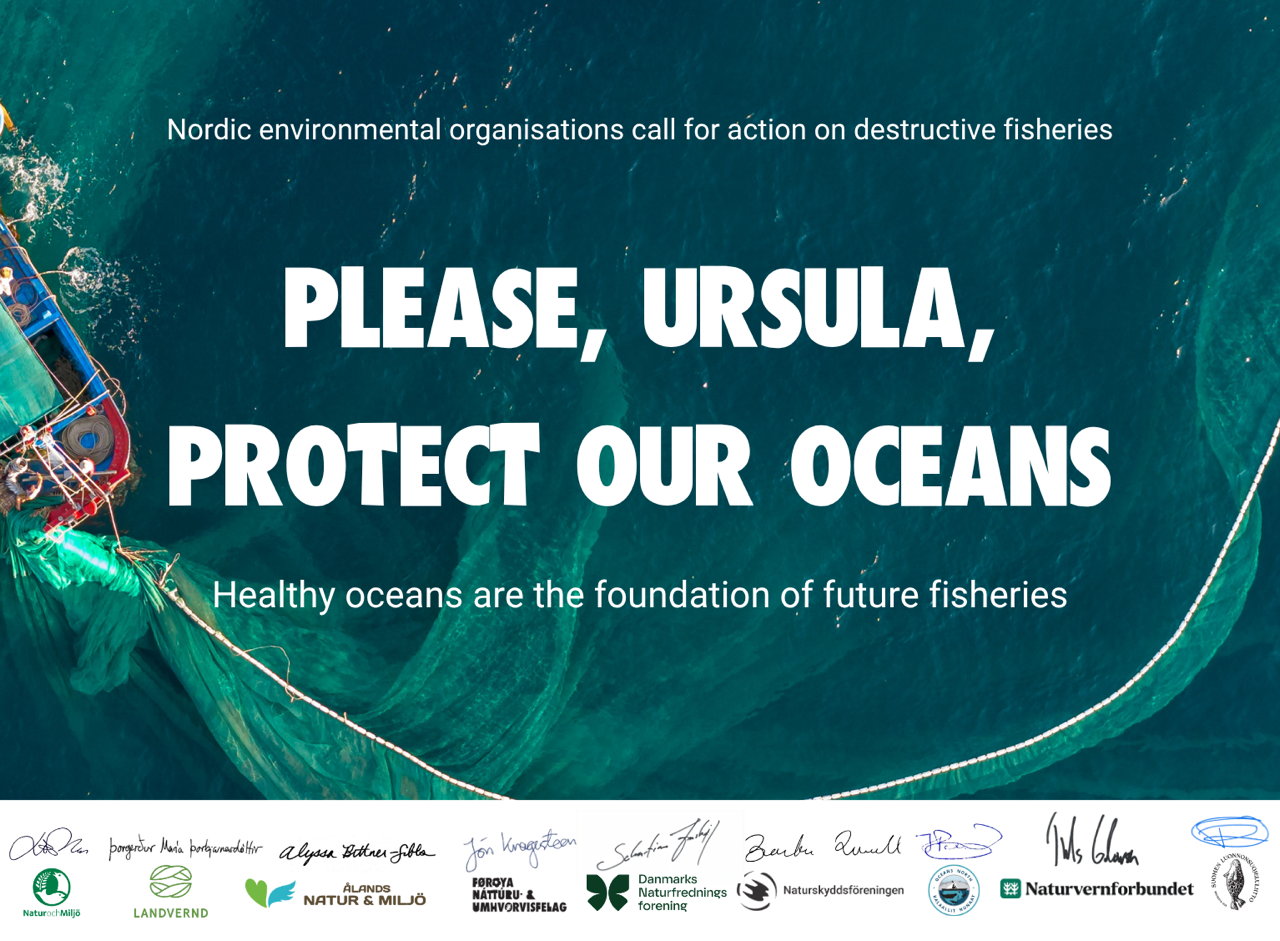
Letter of Concern from the Nordic environmental organizations:
Destructive Fisheries are Undermining CBD and Global Biodiversity Framework Commitments
Madam Executive Secretary,
As Nordic environmental NGOs, we expect our respective governments to take their obligations under the Convention on Biological Diversity (CBD) seriously and hence do their best to respect and implement them.
Similarly, this expectation also applies to those of our countries that are members of the European Union (EU). As the EU has signed the Convention, we have the strongest expectation that the EU Commission will do its absolute utmost to respect and implement the goals.
The situation in the European Union
Unfortunately, this is not currently the case regarding the implementation of the Common Fisheries Policy of the EU.
We are deeply concerned that biologically unsustainable quotas persist in many ICES areas, and that bottom trawling continues in EU marine protected areas, including Natura 2000 sites.
It appears to have become the norm to allow fishing practices that are not sustainable for many fish stocks, as well as practices that damage marine habitats and thus undermine the very basis of those stocks.
The CBD entered into force on December 29th, 1993 [1]. Given this, we would expect that strategies for sustainable use would by now be fully developed, integrated and enforced through EU policies and legislation, in accordance with the Convention article 6, article 8 and article 10.
Furthermore, destructive fishing practices and overfishing are not consistent with the Kunming-Montreal Global Biodiversity Framework (GBF), in particular target 5 and target 10, adopted on December 19th, 2022.
We also note that the EU Commission’s 7th report submitted to the CBD secretariat recognizes that fisheries are still not sustainable [2]. And the recent evaluation of the EU Common Fisheries Policy underscores this as a fact [3].
The situation in individual countries
At the national level, progress is likewise insufficient. According to the report from the Sixth Meeting of the Subsidiary Body of Implementation (SBI-6) held in Rome in preparation for COP17 [4], national targets are falling short to meet the GBF targets.
Overall concerns
Healthy marine ecosystems are the foundation of future fisheries. Allowing continued habitat degradation and overexploitation therefore risks undermining both biodiversity goals and the long-term sustainability of fishing communities.
Destructive fishing practices do not only affect individual species. They can damage entire marine ecosystems, including seabed habitats that support biodiversity, food webs and fish reproduction.
Continued degradation of these ecosystems weakens ocean resilience, undermines biodiversity conservation efforts and may ultimately reduce the long-term productivity of fisheries themselves.
In other words, the continued loss of marine biodiversity is not only a nature issue. It is also a food security issue, an economic issue and a question of intergenerational responsibility.
As Nordic environmental NGOs, we share deep concerns about the lack of ambition when it comes to ocean management, where bottom trawling is still prevalent in fragile and protected areas. In many marine areas, there is still a lack of even any basic registration of the marine habitats present.
We also find it incomprehensible to understand that overfishing continues despite clear evidence that rebuilding healthy fish stocks would allow for greater long-term yields and provide stronger economic benefits.
Recommendations
With COP 17 approaching in October, we recommend that specific attention be given to unsustainable fisheries in the EU and our Nordic countries. Sustainable use of marine living resources is fundamentally critical, and fulfillment of the CBD and GBF targets is correspondingly critical.
Therefore, we encourage that the “Global Biodiversity Framework Global Review” will include:
- a strong and critical focus on the gaps in implementation and enforcement of CBD targets by the European Union and our Nordic countries
- a strong and forward-looking recommendation to strengthen action on the sustainable use of marine resources;
- a strong recommendation to ensure the necessary mapping of marine habitats.
Signed,
Nordic environmental organizations
Truls Gulowsen
President Naturvernforbundet
Alyssa Bittner-Gibbs
Chair of the Board Ålands Natur & Miljö
Beatrice Rindevall
President
Swedish Society for Nature Conservation
Josefine Egenfelt
Director
Ålands Natur & Miljö
Sebastian Jonshøj
President
Danish Society for Nature Conservation
Jenseraq Poulsen
Executive Director
Oceans North Kalaallit Nunaat
Jón Kragesteen
Chairperson
The Faroese Nature Conservation Association
Þorgerður María Þorbjarnardóttir
Chairperson
Landvernd – Icelandic Environment Association
Tapani Veistola
Executive Director
Finnish Association for Nature Conservation
Copy of this letter sent to:
European Commission, Ursula Von der Leyen
National Governments
European Parliament Committee on Environment, Public Health and Food Safety (ENVI) Nordic Council of Ministers
HELCOM and OSPAR secretariats (for information)
References
[1] CBD Introduction
[2] https://environment.ec.europa.eu/publications/7th-national-report-cbd-progress-implementation-global-biodiversity-framework_en
[3] Register of Commission Documents – SWD(2026)120
[4] https://www.cbd.int/doc/c/4fc4/fb7a/aee60317b2bf743207635649/sbi-06-inf-05-en.pdf
Ajankohtaista
-
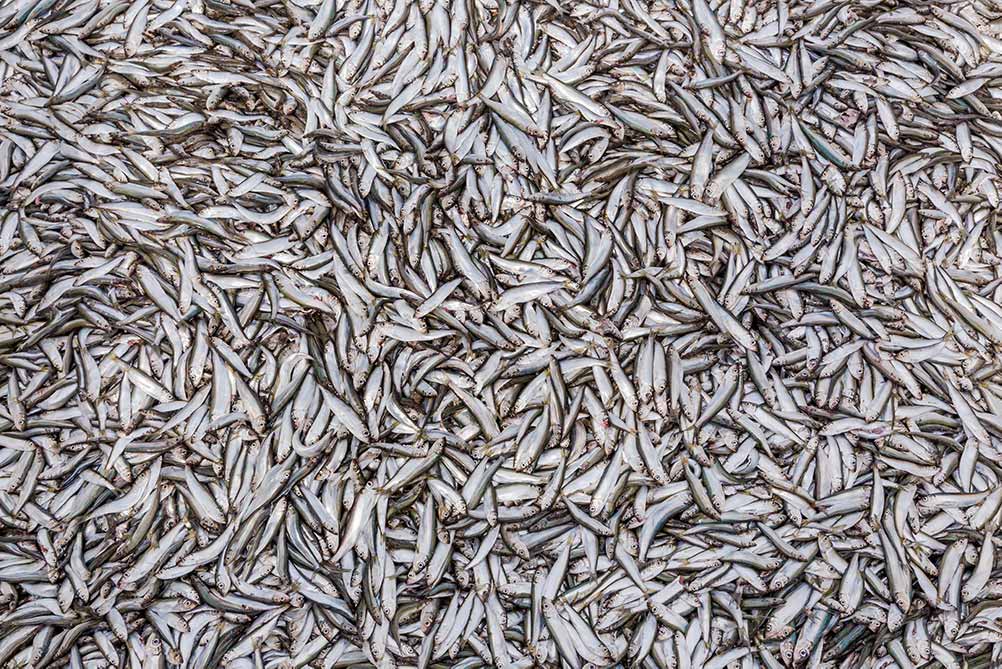
Silakka on Suomen merikalastuksen pääsaalis. Kuva: Juha Sulin / Vastavalo Luonnonsuojeluliiton lausunto kalastuspolitiikan perusasetuksen arvioinnista
EU:n yhteinen kalastuspolitiikka ja ns. perusasetus ovat pääosin kunnossa. Siksi Suomen kannattaisi ensisijaisesti pitää ne ennallaan eikä ajaa niiden avaamista EU:ssa.LUE LISÄÄ: Luonnonsuojeluliiton lausunto kalastuspolitiikan perusasetuksen arvioinnista -
Silakka on Suomen merikalastuksen pääsaalis. Kuva: Juha Sulin / Vastavalo Luonnonsuojeluliiton lausunto kalastuspolitiikan kansallisen täytäntöönpanolain muuttamisesta
Luonnonsuojeluliitto kannattaa kotimaisen kestävästi pyydettyä luonnonkalaa. Hallitus esittää kalastukseen pieniä helpotuksia, joita liitto kannatti lausunnossaan eduskunnalle.LUE LISÄÄ: Luonnonsuojeluliiton lausunto kalastuspolitiikan kansallisen täytäntöönpanolain muuttamisesta -
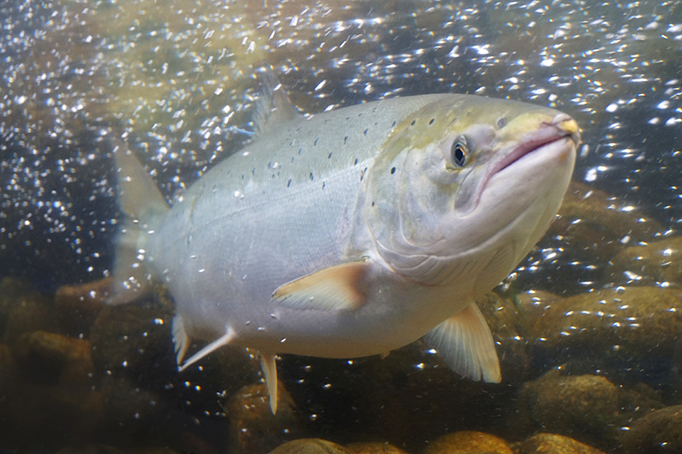
Kuva: iStock Valtioneuvoston kirjelmä eduskunnalle yhteisen maatalouspolitiikan (YMP) ja yhteisen kalastuspolitiikan (YKP) uudistuksesta – lausunto kalastuspolitiikan osalta
Luonnonsuojeluliitto muistutti eduskunnan maa- ja metsätalousvaliokuntaa ympäristötoimien tärkeydestä kalastusta koskevien EU-rahastojen muutoksisissa.LUE LISÄÄ: Valtioneuvoston kirjelmä eduskunnalle yhteisen maatalouspolitiikan (YMP) ja yhteisen kalastuspolitiikan (YKP) uudistuksesta – lausunto kalastuspolitiikan osalta